
Current-carrying capacity (Iz) with correction factors
Pick the cross-section, method and insulation, set ambient, grouped circuits and whether the cable is in thermal insulation; Lastsocket returns Iz after factors and compares the load against it, PASS or FAIL.
Limits and citations come from the app's pack files. The calculator below is checked against the app's engine on every build · engine 1.
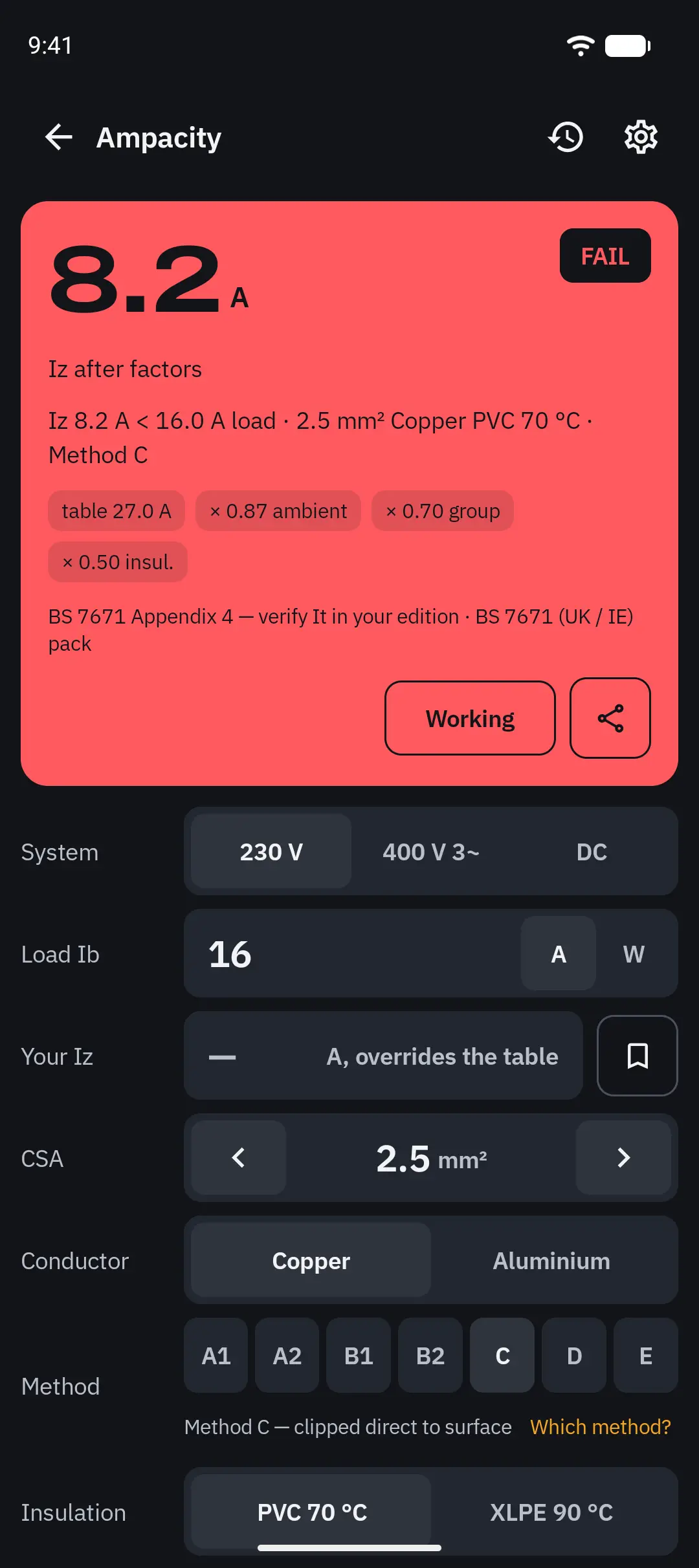
The same job in the app
2.5 mm², method C, 40 °C, 3 circuits grouped, in thermal insulation: Iz 8.2 A against a 16 A load — FAIL.
How it's calculated
Iz = Itable × Kambient × Kgrouping × Kinsulation. Ambient factors are relative to 30 °C air; grouping factors apply to touching cables; thermal insulation applies 0.5 for a cable enclosed over 0.5 m, and shorter lengths have their own factors.
Values are consistent with IEC 60364-5-52 Annex B for methods A1, B2, C and E, PVC copper, to 50 mm² — a subset, not a reproduction of any national table. Always confirm Iz in your edition and in the manufacturer’s data.
The number of loaded conductors is a required input: two for single-phase and DC, three for three-phase, and the three-phase column is lower.
Worked example
2.5 mm² copper PVC, method C, two loaded conductors: 27 A. At 40 °C (×0.87), 3 circuits grouped (×0.70) and in thermal insulation (×0.5): 8.2 A. A 16 A load fails.
Questions
Why is three-phase lower?
Three loaded conductors heat the cable more than two; the standard has a separate column.
Where do the numbers come from?
See Sources and limits, linked above. The bundled values are a subset; your own value from the book always wins.