
Cable size calculator — Iz and voltage drop, both gates
Give the design current, the breaker, the installation method and the run; Lastsocket walks the IEC 60228 sizes upward until a cross-section passes both gates: Iz after correction factors ≥ the breaker rating, and voltage drop within the limit in your pack. It shows the coordination line Ib ≤ In ≤ Iz with ticks, and each smaller size with the gate that rejected it.
Limits and citations come from the app's pack files. The calculator below is checked against the app's engine on every build · engine 1.
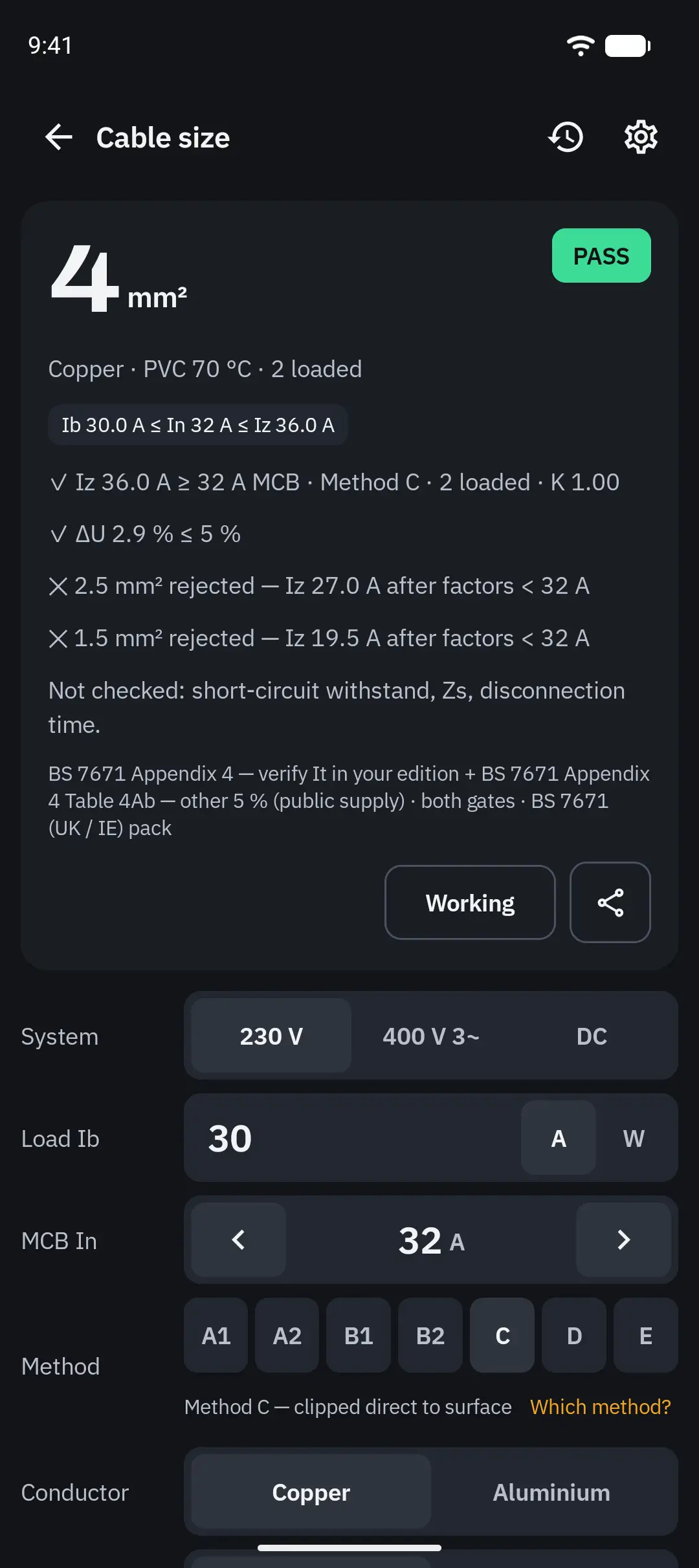
The same job in the app
30 A on a 32 A breaker, method C, 20 m: 4 mm² with Iz 36 A and a 2.9 % drop — PASS on both gates.
How it's calculated
Gate 1: Iz = Itable × Kambient × Kgrouping × Kinsulation, where the table value depends on installation method, insulation, conductor material and the number of loaded conductors — two for single-phase and DC, three for three-phase, and the three-phase column is lower. The app bundles methods A1, B2, C and E, PVC copper, to 50 mm² today.
Gate 2 is the voltage-drop calculation, at operating temperature. The breaker defaults to the next standard rating above the design current, and the cable must carry the larger of the two.
Worked example
Single-phase 30 A on a 32 A breaker, method C, PVC copper, 30 °C, one circuit, 20 m: 1.5 mm² (19.5 A) and 2.5 mm² (27 A) are rejected on Iz; 4 mm² gives Iz 36 A ≥ 32 A and a 2.9 % drop against 5 % — PASS on both gates, exactly as the screenshot shows.
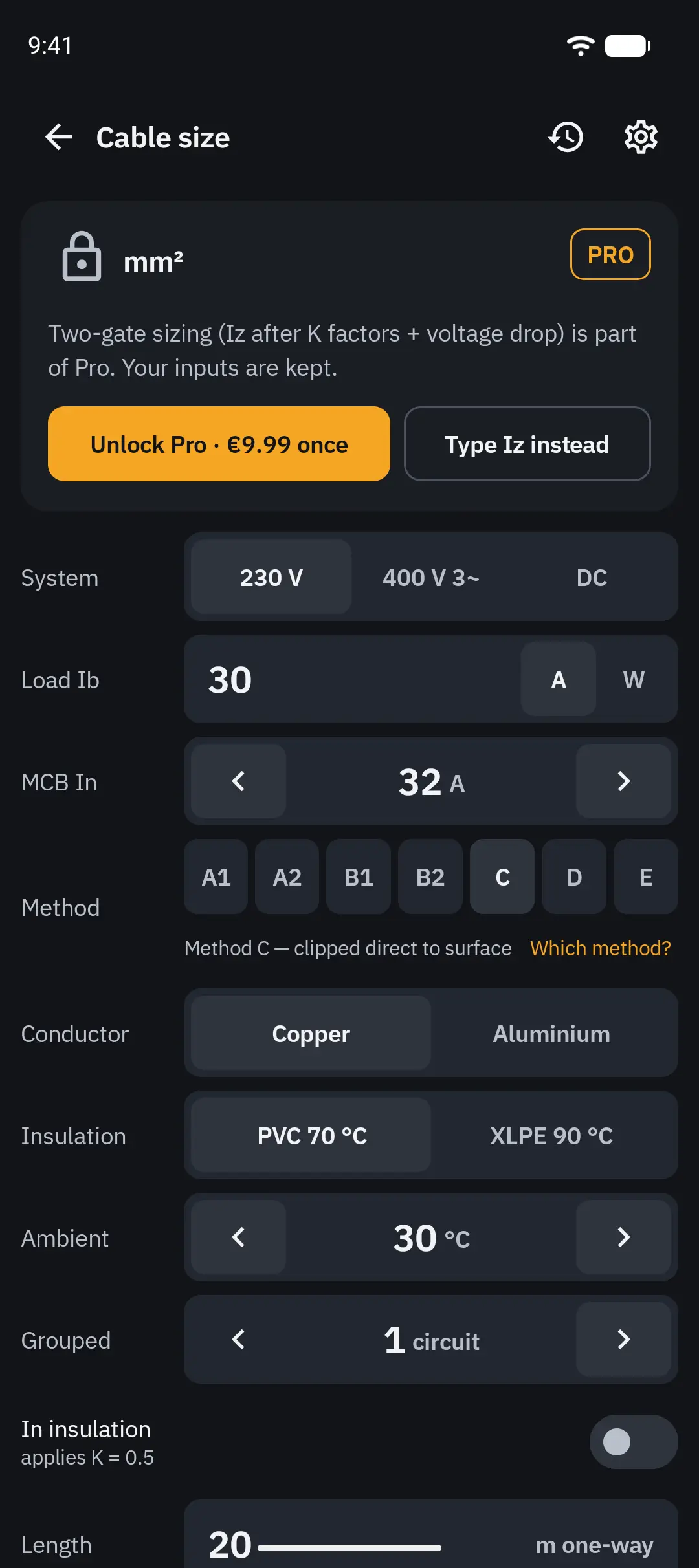
More from this screen
Questions
What if Iz equals the breaker exactly?
The gate is Iz ≥ In after factors, so a tie passes; a hot ambient or a second grouped circuit is what pushes it under.
Which installation method is mine?
Tap "Which method?" in the app for a description of each.
What about aluminium?
From 16 mm² only, as in the standards.