
12 / 24 / 48 V DC voltage drop — why 3 % is so hard
The same calculation as AC without the power factor: ΔU = 2 · I · L · rθ. At 12 V the percentage runs away fast, and the app warns you before you start.
Limits and citations come from the app's pack files. The calculator below is checked against the app's engine on every build · engine 1.
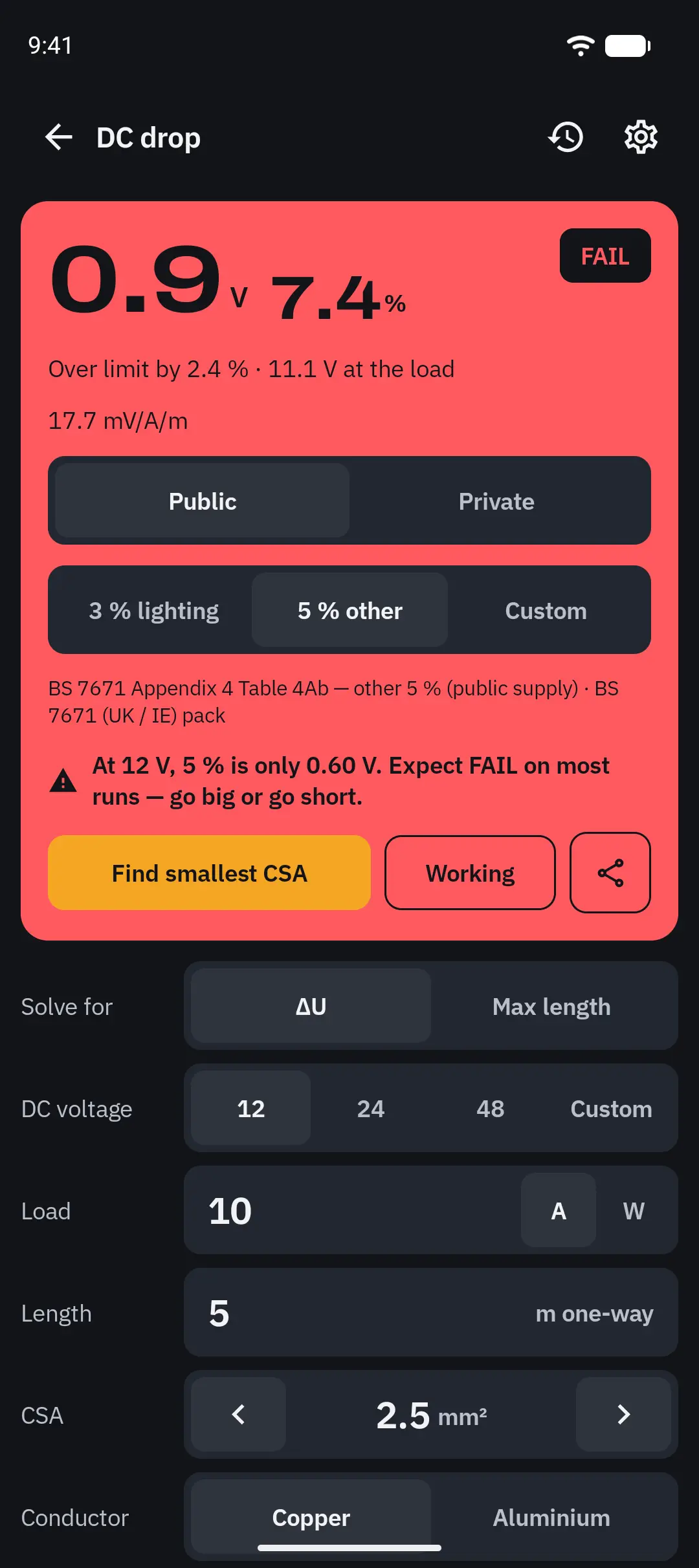
The same job in the app
10 A over 5 m on 2.5 mm² at 12 V DC: 0.9 V, 7.4 % — FAIL at 5 %.
How it's calculated
ΔU = 2 · I · L · rθ, with rθ the IEC 60228 resistance for the cross-section at the conductor’s operating temperature, exactly as on the voltage drop page. There is no power factor and no reactance.
What changes is the voltage underneath. The same volts lost on a 12 V circuit are a far bigger share than on 230 V, so a run that would be trivial on mains needs a much larger cross-section or a much shorter length. The DC mode offers 12, 24 and 48 V.
Worked example
10 A, 5 m one way, 2.5 mm² at 70 °C: 2 × 10 × 5 × 0.00887 = 0.89 V, which is 7.4 % of 12 V — FAIL at 5 %. One size up, 4 mm², comes to 4.6 %.
Questions
Should I use 20 °C for a short DC run?
The option exists and is labelled optimistic; use it only for a lightly loaded cable.
Does the length include the return?
No — enter the one-way length; the formula doubles it.